


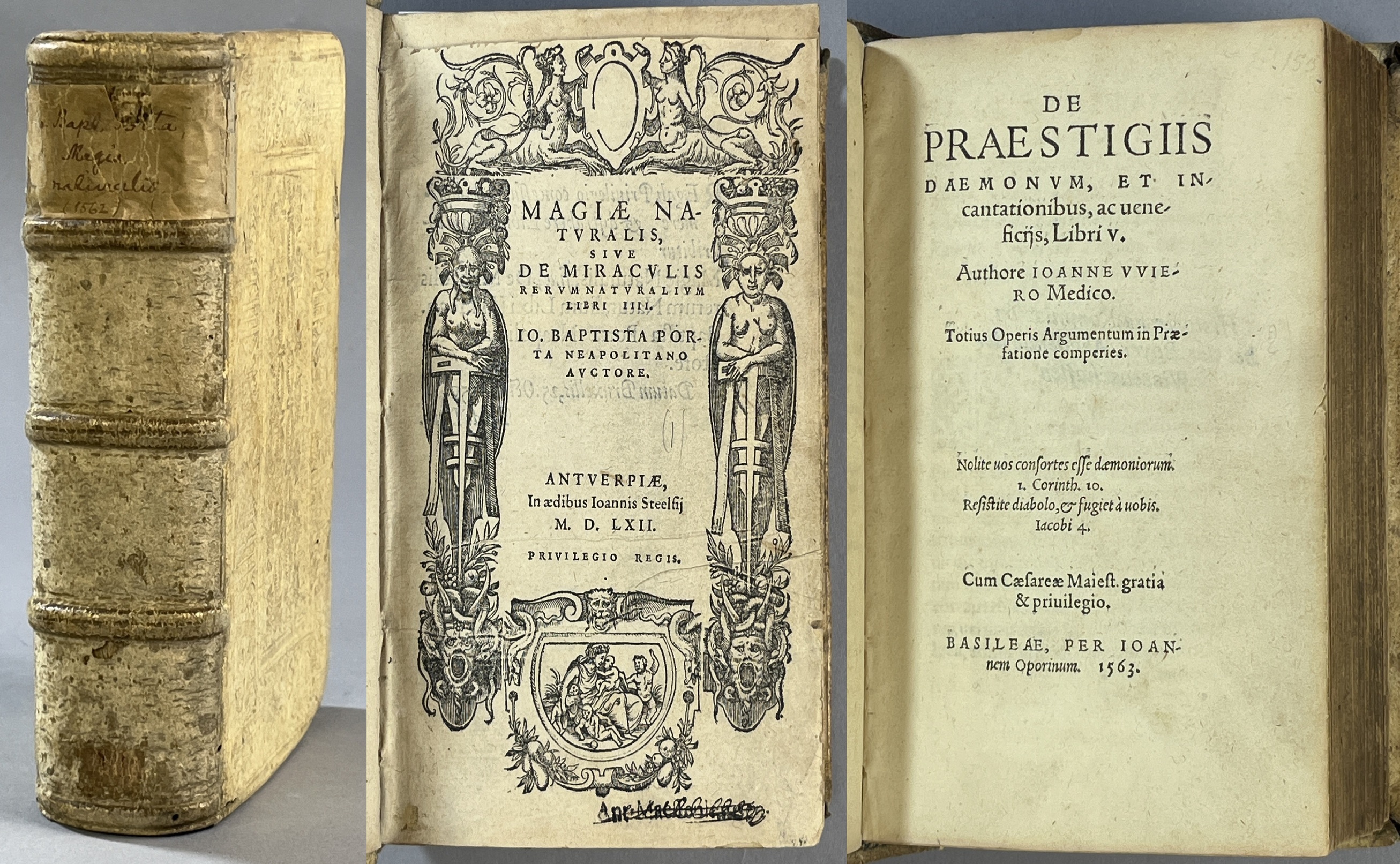
Magiæ Natvralis, Sive De Miracvlis Rervm Natvralivm Libri IIII. Io. Baptista Porta Neapolitano Auctore. [bound with:] De Præstigiis Daemonvm, Et Incantationibus, ac ueneficijs, Libri V. Authore Ioanne VViero Medico. Totius Operis.
[Porta, Giambattista della (1535-1615)] & [Weyer, Johann (1515-1588)].
pix100981
Antverpiæ, In aedibus Ioannis Steelsii, M.D.LXII. [1562] & Basileæ, Per Ioannem Oporinum, 1563. 8:o. (15) pp., 135 lvs, (1 blank). Woodcut device on title, woodcut initials; 479 pp. Contemporary decorated pigskin with three raised bands, handwritten title-label to spine. Missing both clasps. Title somewhat shaved at upper margin, a few outer and partly upper margins lightly waterstained, a bit heavier at the last three quires. First volume’s first quire with a few small wormholes, extended at the title page and inside of the front cover. Second volume’s last quire with small wormhole at outer margin. Porta: Leaf 11 with pagination omitted. Leaf 21 misnumbered 23, leaf 23 misnumbered 21, leaf 53 misnumbered 35, leaf 107 misnumbered 701. Stamped ‘Historische Kommission / bei der Bayer. Akademie der / Wissenschaften’ inside front cover and verso 2nd title & ‘Bibliothek Lossen / No [67]’ on fly-leaf. Crossed out signature on 1st title. From the library of Denis Leigh, with his name label on fly-leaf.
122 000 kr
Porta: Sallander ‘Bibliotheca Walleriana’ 20134 (1644 ed.). Wellcome 5180. Not in Durling. Weyer: Sallander ‘Bibliotheca Walleriana’ 20402 (1577 ed.). G&M 4916. Norman cat 2209. Grolier One Hundred Books (medicine) 20. Durling 4734. Grässe ‘Bibliotheca magica et pneumatica’ VI:448. Kernot ‘Bibliotheca Diabolica’ p. 5. Robbins ‘The Encyclopedia of Witchcraft and Demonology’ p. 538-540. Not in Wellcome or BMC. According to Worldcat only registred in 5 and 4 libraries respectively. Two of the most influential works in the late 16th century bound together. Porta: This book represents the work of one of the earliest Italian scientific institutions, the Accademia dei Segretti, a forerunner of the Accademia dei Lincei and the other great scientific societies of the seventeenth and eighteenth centuries. It epitmises the combination of credulity and empiricism tyical of the late Renaissance (Norman 1726). Weyer: The first major European work to make an empirical, scientific approach to the study of mental illness. At the height of witchcraft delusion he argued that witches were mentally ill women who deserved humane treatment instead of torture and punishment. Weyer reduced the clinical problems of psychopathology to simple terms of everyday life and everyday, human, inner experience (Zilboorg).
Fler böcker i samma kategori
-
![Hemmets prydnadsföremål, som vi göra själva [= pärmtitel].](http://www.genealogica.com/svaf/92888.jpg)
Hemmets prydnadsföremål, som vi göra själva [= pärmtitel].
pix92888200 kr Lägg i varukorgNathhorst, Birgit.
pix92888
Stockholm, Åhlén & Åkerlunds Boktryckeri, 1933. 8:o. 46, (2) s. Illustrerad. Förlagets blå klotband med illustrerat pärmpapper. -

Album scholæ Arosiensis 1618-1650.
pix8432250 kr Lägg i varukorgMolér, Wilhelm (1847-1928).
pix8432
Västerås, A. F. Berghs Boktryckeri, 1905. 8:o. (4), 70 s. Trådhäftad med styvt tryckt ljusgrönt pappersomslag. Lätt nött rygg. Liten fläck på bakre omslag. Stämpel på främre omslag. Exlibris på titelbladets versosida. -

F.d. bryggare-embetets i Stockholm pensionskassa åren 1847-1900. Anteckningar från handlingar i kassans arkiv. Enligt beslut vid årsmöte den 12 mars 1903 utgifna af pensionskassans delägare.
pix7767650 kr Lägg i varukorgBjurholm, Anders.
pix7767
Stocklholm, Å. Palmquists Aktiebolag, 1905. Stor 8:o. (7), 302 s., 25 pl.-bl. Illustrerad. Förlagets bruna halvklotband med ryggtitel i guld, marmorerat pärmpapper och dito snitt.