


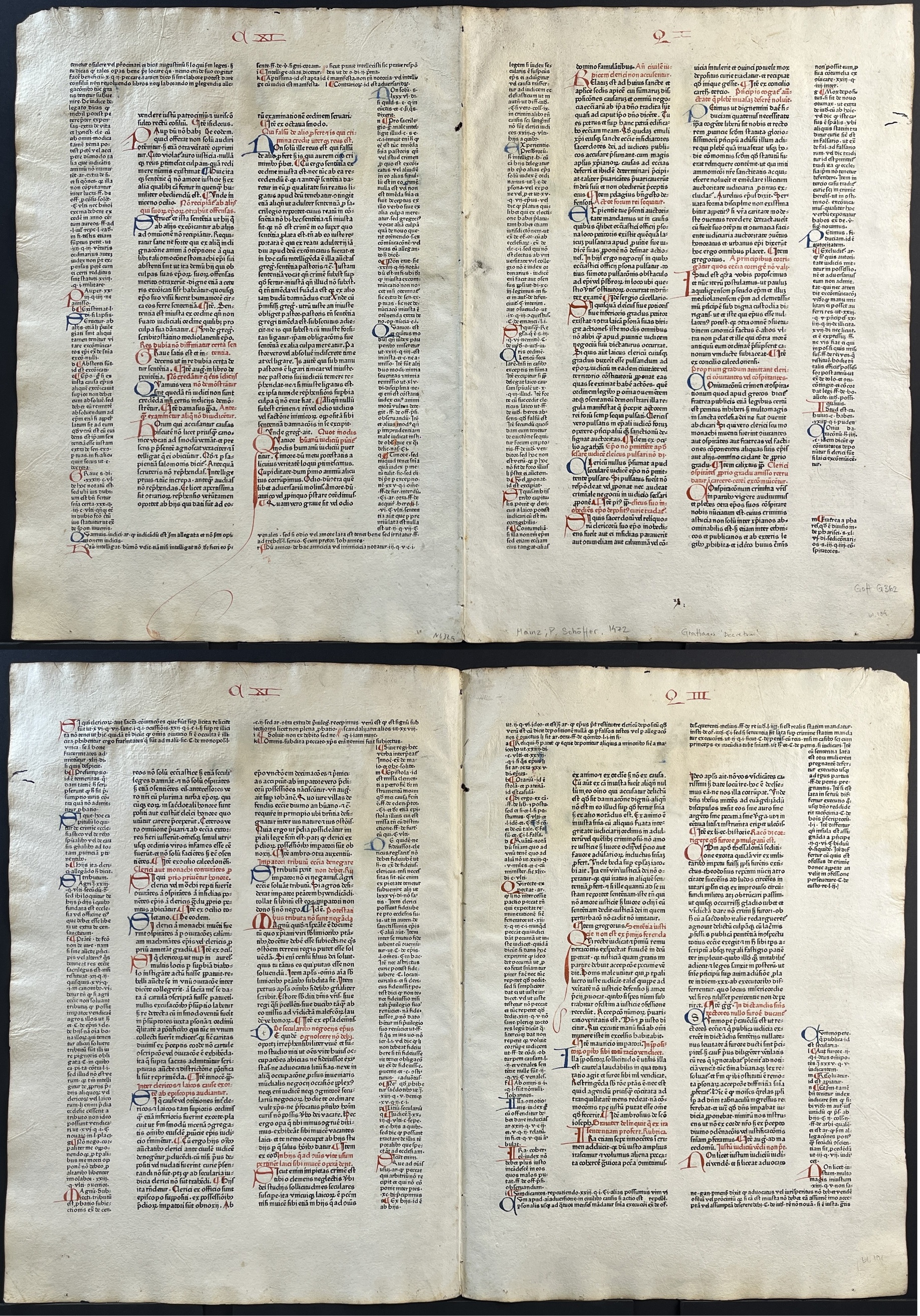
Biblia latina. With the Glossa ordinaria attributed to Walafrid Strabo and others, and the interlinear gloss of Anselm of Laon.
[Inkunabel]
pix84479
[Strassburg, Adolf Rusch, for Anton Koberger at Nuremberg, not after 1480]. Folio. Bifolio [from volume three]. Leaf 167 + 170 [out of 299]. 470×652 mm. Gothic type. 45 lines of text without interlinear commentary, 73 lines of commentary, and headline, double column. Types: 1:180G (headlines, text incipits), 2:106G (text, commentary incipits), 3:92G (commentary), 4:68G (interlinear commentary). Initial spaces. Two illuminated initials in red and blue, red capital strokes, alternating red and blue paragraph signs. Some faint dampstain to lower margin.
8 950 kr
Goff B607; HC 3173*; GfT 1246; Pell 2352; CIBN B-427; Hillard 401; Aquilon 123; Buffévent 89; Parguez 190; Péligry 172; Richard 109; Torchet 151; Zehnacker 445; Polain(B) 682, 682A; IGI 1684; IBE 1041; IDL 834; IBP 1038; Kotvan 250; Sajó-Soltész 660; Gspan-Badalic 114; IBPort 330; CCIR B-77; IJL2 89; SI 766; Mendes 226; Madsen 695, 696; Coll(U) 312; Louda 373; V. Jugareanu, Catalogul colectiei de incunabule (Sibiu, 1969) 72, 73; Martín Abad B-135; Nentwig 78; Ernst(Hildesheim) II,II 73; Günt(L) 2964; Voull(B) 2133; Voull(Trier) 1286; Leuze(Isny) 76, 77, 78; Ohly-Sack 545, 546, 547; Sack(Freiburg) 656; Hubay(Augsburg) 378; Hubay(Eichstätt) 181; Hummel-Wilhelmi 111, 112, 113; Borm 458; Schlechter-Ries 295; Finger 184, 185, 186; Kind(Göttingen) 673, 674; Wilhelmi 144; Döring-Fuchs B-195, B-196, [B-197]; Walsh 139, 140, 141; Oates 124; Rhodes(Oxford Colleges) 359; Bod-inc B-314; Sheppard 320, 321; Pr 299; BMC I 92; BSB-Ink B-442; GW 4282; Fac: ed. K. Froehlich and M.T. Gibson, Turnhout, 1992. A crisp, wide-margined leaf. First edition of the Latin Bible with the Glossa ordinaria, the standard Bible commentary of the later eleventh and early twelfth century, composed by Anselm of Laon, Ralph of Laon and Gilbert of Auxerre. The layout preserves the traditional manuscript format, distinguishing the Biblical text from the Glossa ordinaria surrounding it, and from the interlinear gloss, which usually consists of definitions or paraphrases of specific words. Glossed manuscript Bibles of the twelfth century were usually divided into multiple volumes, a fact that may be reflected in the many compositional units of the present edition. The unusual method of quire signing found in this edition, in which the signatures consist of the first seven letters of the alphabet repeated non-sequentially, does not indicate the order of the quires. Rather, these letters appear to be a form of press figure, each letter referring to one of the seven presses used to print the work. Three of the four type fonts used in the edition were also used by Johann Amerbach of Basel, from whom Rusch is known to have borrowed types and with whom he corresponded regularly. Albert Hartmann, editor of Amerbach's correspondence, attributed the edition to him, an opinion reflected for a time in the literature of incunable studies. The letters, however, make reference to the loan of types and speak of the Bible in terms which imply that it was Rusch's. They also indicate that Rusch was under contract to Anton Koberger of Nuremberg for the marketing of the edition, but that he kept about one hundred copies at Strassburg to sell on his own account. The edition is dated from inscriptions in the Cambridge University Library and Sion College copies which imply that those copies were purchased in 1480. Rubrication inscriptions in Munich and Budapest copies are dated 1481.
Fler böcker i samma kategori
-
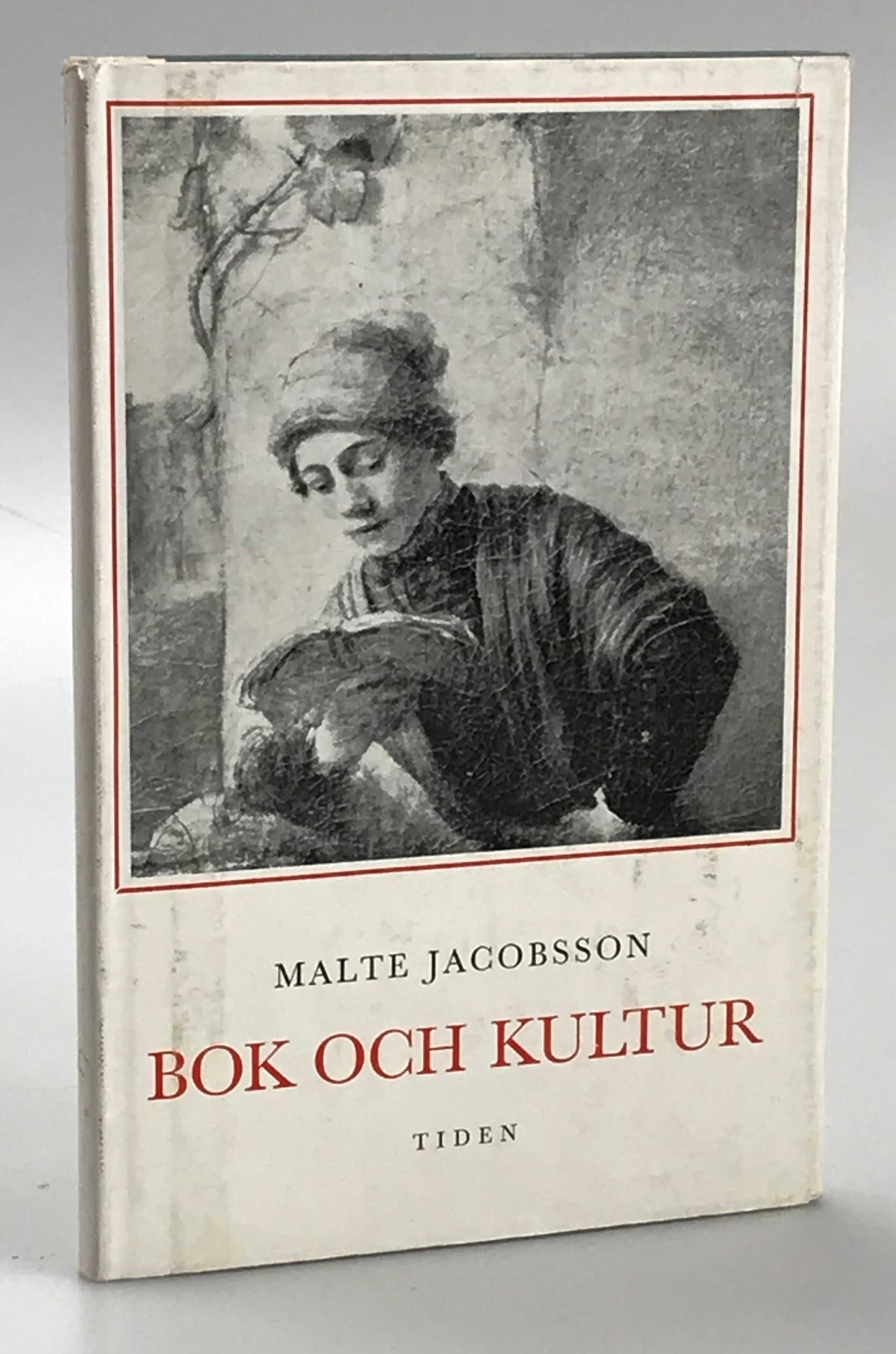
Bok och kultur.
pix15086100 kr Lägg i varukorgJacobsson, Malte (1885-1966).
pix15086
Stockholm, Tiden-Barnängens Tryckerier AB, 1958. 8:o. 79, (1) s. Illustrerad. Förlagets klotryggband med illustrerat skyddsomslag. -

The History of the Illustrated Book. The Western Tradition. With 465 illustrations 33 in colour.
pix12143650 kr Lägg i varukorgHarthan, John.
pix12143
London, Thames and Hudson Ltd., 1981. Folio. 288 pp. Illustrated. Publisher's brown cloth with gilt title on spine, illustrated and slightly tanned dustjacket. Dust jacket with somewhat sunned spine. -
![Nya forskningar till Gutenbergsjubileet. [= rubrik].](http://www.genealogica.com/svaf/38439.jpg)
Nya forskningar till Gutenbergsjubileet. [= rubrik].
pix38439200 kr Lägg i varukorgCollijn, Isak (1875-1949).
pix38439
Stockholm, Bröderna Lagerström, 1942. 4:o. s. 11-12. Klammerhäftad med styvt tryckt något ojämnt solbränt pappersomslag. Tillskrift ‘Fr. Förf.’ på främre omslaget.